Who are you? Should we take the results of personality tests at face value?
If we take the definition of personality as to broadly mean ‘some indication of the reasons behind current behaviour’ (and also an indicator of future behaviour) in given circumstances, we can see that the concept incorporates powerful psychological processes such as perception, our cognition and our emotions.
How we think and feel about a situation (psychological reality) will definitely affect our behaviour, and our behaviour is the prima facie evidence of our personality, as judged by others. Behave like this in situation A, and observers will predict that behaviour will be repeated when situation A is encountered again (Kelly, 1973). [Kelley, H. H. (1973). The process of causal attribution. American psychologist, 28(2), 107-128].
Sometimes the influence of the environment is heavily discounted or ignored altogether and thus
‘personality’ becomes a universal index for predicting our emotional, cognitive and behavioural tendencies across all environments. [Malle, B. F. (1999). How people explain behaviour: A new theoretical framework. Personality and Social Psychology Review, 3, 1: 23-48].
Psychologists, when measuring personality typically rely upon the individual’s current ‘answering-questions’ behaviour about past behaviour.
For example, agreeing with the statements “I keep my belongings neat and clean” and “I often feel nervous in the presence of others” and disagreeing with the statement “I tend to laugh a lot”, might indicate that you have a predisposition to be ‘neurotic’……apologies, let’s say emotionally sensitive!
These are questions about past behaviour. The enquiries are seldom (if ever) about what you plan to do in the future. My next New Year’s resolution could very well be to keep my belongings neat and clean.
How should we consider these snapshots of self-reported behaviour? Is the act of completing a questionnaire verbal or non-verbal behaviour? When the respondent is required to read a statement and circle a number on a Likert-style scale to indicate strength of agreement or disagreement with the behavioural description; what does the circled number represent?
This initial number, which represents a response ‘category’, and is, in statistical terms, nominal data, is treated as quasi-arithmetical and labelled ‘interval data’. Several pieces of interval (now parametric) data are then added together and treated as an accurate measure of past behaviour. These measurements can be averaged amongst populations and ‘norms’ calculated; these become the basis for psychometrics.
Question: “What do you do with your belongings?”
Response: “I keep them neat and clean”.
This is verbal data.
Statement: “I keep my belongings neat and clean”
Response: Circling a number from 1 to 5 (or 7 or 9), indicating from ‘never’ to ‘always’ or ‘strongly disagree’ to ‘strongly agree’); is this also verbal behaviour?
Also, how does a ‘4’ or ‘5’ relate to an individual’s personality?
Or if we are more accurate, what does a score of 4.5 compared with an average (or norm) of 3 tell us about a person’s character?
Here we are treating non-verbal data as representing a human characteristic. We are evaluating past (and predicting future) behaviour from a sample of current non-verbal behaviour; we are using non-verbal cues (numbers) to judge another’s personality. We are using a number as a metaphor for a dimension of personality.
Do we use numbers solely to give this practice of people-profiling a veneer of both scientific objectivity and accuracy? Compare these two evaluations:
1. “He gets a bit nervous in certain circumstances”
2. “The population norm for the N personality dimension is 15.4 and he has a score of 19.0”.
The second statement appears to be more scientific and objective; however we should ask ourselves which evaluation is more useful and even, which is more accurate in terms of using the information as a base for future decision-making?
Of course, arriving at a judgement about a person’s character based upon non-verbal cues has not always appeared to be so scientific. The idea that outward external cues are somehow a reflection of an individual’s inner character has a long history and sometimes not a particular noble one, being associated with the eugenics movement, which was widely followed during the twentieth century. [http://en.wikipedia.org/wiki/Eugenics].
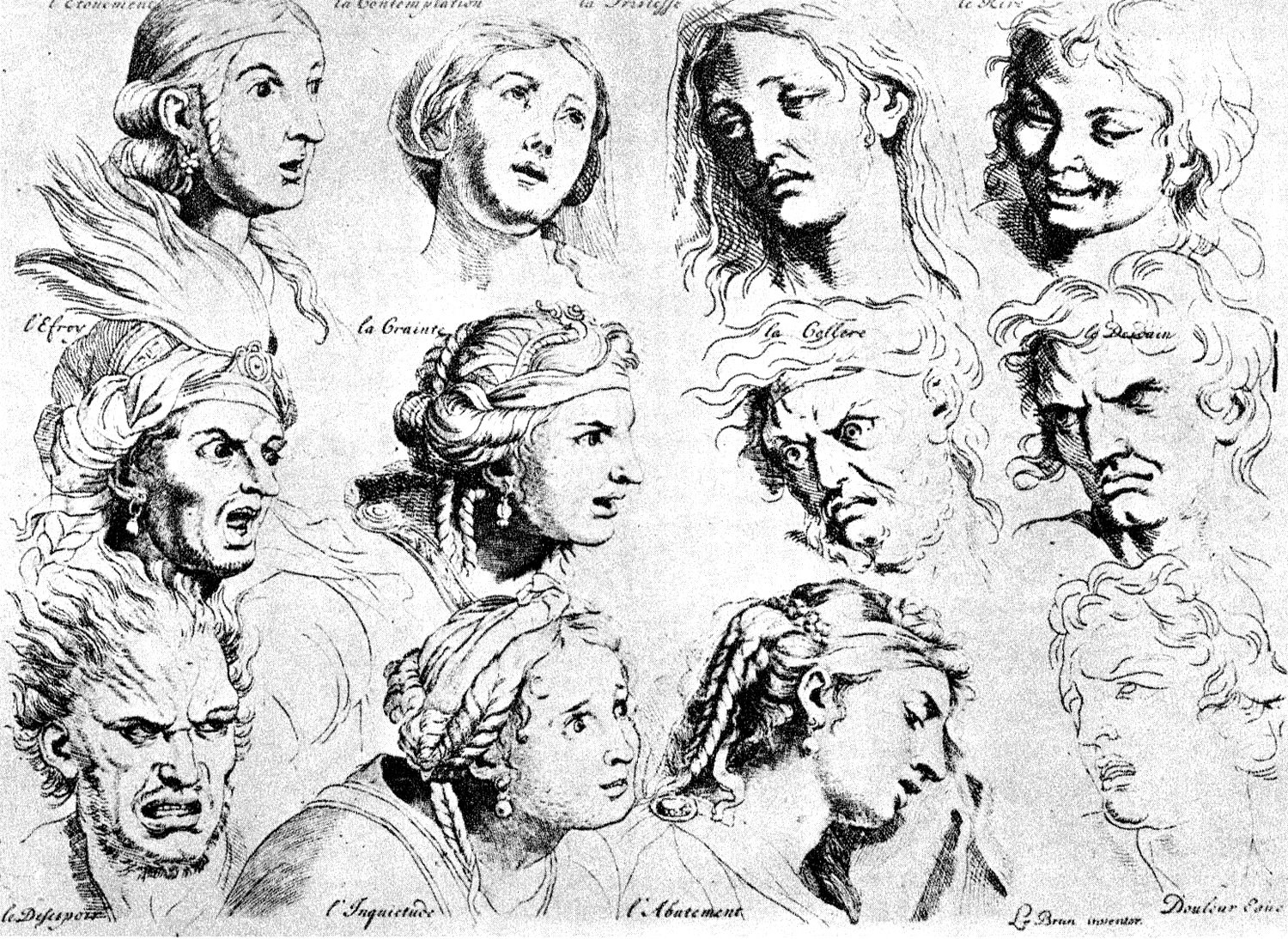
The external cues mostly focussed upon belong with the facial features of individuals. These features include the shapes and positions of major areas of the face, such as the forehead, eyebrows, nose, cheeks, and mouth. The study of such relatively unchanging features is called ‘physiognomy’ and is the art (or science) of interpreting of these physical characteristics as indexical signs, or visible traces of the inner ‘personality’ of the individual.
The shape of a nose or the colour of skin is relatively static and therefore would seem able to indicate only underlying meta- tendencies or predispositions. However, there also remains the possibility that repeated transient experiences, such as often elicited emotions, might accumulate some kind of residual trace on the face and leave a visible effect on such slowly changing features. Indeed, Charles Darwin referred to how “different persons bringing into frequent use different facial muscles, according to their dispositions; the development of these muscles being perhaps thus increased, and the lines or furrows on the face, due to their habitual contraction, being thus rendered more conspicuous.” So a generally happy and extraverted soul might look just that with the onset of ‘smile lines’, and a sad and gloomy pessimist might betray their inner disposition with a fixed scowl and censorious look. [http://www.classicsarchive.com/E/books/Expression_Emotion_in_Man_&_Animals_-_Charles_Darwin/?page=403].
Passini and Warren (1966)[1] reported a correlation between the evaluation of facial features by naïve observers and scores obtained through a psychometric personality test (the NEO5).
More recently, Little and Perrett (2007)[2] also found a link between facial appearance and personality.
Are both these studies just reporting instances of correlations between different kinds of non-verbal cues that we, as observers, are using as an indication of implicit personality characteristics?
If they correlate positively with each other, again we may ask, which judgement is more useful and which is more accurate? We have the instant intuitive evaluations of faces compared with the much slower psychometric measure.
Should we really be taking personality tests at face value?
[1] Passini, F. T. & Warren, N. T. (1966). A universal conception of personality structure? Journal of Personality and Social Psychology, Vol. 4(1), p 44-49
[2] Little, A. C. & Perrett, D. I. (2007). Using composite images to assess accuracy in personality attribution to faces. British Journal of Psychology, Vol. 98, (1), pp 111–126