Corporate Responsibility and Ethics: An argument for Government intervention into the running of Football Clubs in the UK.
Ethical principles provide the foundations for a broader decision making framework that will be needed by future successful football clubs. The ‘big’ professional clubs, through a more enlightened view of what a football club constitutes, will have to increasingly recognize their responsibilities to a wider constituency than the exclusively profit-oriented owners and shareholders.
The ‘Modern’ football club will be forced increasingly to concern themselves with:
- Governance (Ethics & Morality)
- Employee (including players) well-being
- Social responsibility (to local communities)
- Sustainability
- Environmental costs
- Legacy
Governance
Traditional business models, which grew out of ‘industrialization’ (1800’s), have meant that some football cubs have define ‘success’ in terms of growth in profits, in market share and in capital value (share price). The larger clubs have transformed themselves into limited liability companies and are owned by a number of shareholders and run by directors. The role of the directors within the club is to ensure that it is run legally via the management for the benefit of the shareholders/owners. There is no legal obligation to ‘take-care-of’ the fans, or anyone else for that matter.
The bigger football clubs are now better thought of as ‘organizations’, which are legal entities for business purposes, but with the increase in the use of advertising, marketing and branding, football clubs have acquired a public-image, brand or reputation that is almost a personality, that supporters emotionally identify with.. A club’s public-image or reputation is now seen as having a very important role in maintaining ‘success’; ‘brand-image’ affects sales, profits, share-price, recruitment and ultimately performance, both on and off the pitch.
In the future, more sophisticated clubs may need to be directed from an ‘internal-motivation’ to provide good governance. This would involve the self-monitoring of the organization’s decision-making in an attempt at ‘fairness’ & respect in the dealings with other stakeholders. What is ‘fair’ would be-by- and-large determined by the prevailing attitudes of supporters and/or the wider public.
Social responsibility
This is having a concern for the impact the football club’s activities are having on:
- The health and well-being of players and employees (and non-employees in the local community)
- The local and wider environment
- The sustainability of the activities of the club
- The probity of the club’s dealings with other people and businesses
Organizational benefits
- Supporters and the general public are becoming more educated and more sophisticated and will increasingly favour football clubs (businesses) that demonstrate values reflecting good governance and ethical practices. This will provide the business with a competitive advantage in terms of greater support, increased revenue and maybe even profits.
- In the future, people will increasingly want to be associated with environmentally responsible and ethically-minded organizations. To attract and retain employees with the required character, temperament and potential, organizations will need enlightened leadership that fosters a particular type of culture within the football club.
- A work-place culture that values responsibility, respect and integrity will generate players (and employees) who have an enhanced sense of well-being. This leads to a greater optimism, a deeper engagement and a more powerful motivation. These emotions are infectious and are felt by other stakeholders in the club, leading to a general ‘feel good’ factor.
- Eventually, fewer investors will be interested in risking their money in a football club-business that lacks integrity and responsibility. Apart from a pessimistic outlook for long-term performance, can the details in the prospectus ‘selling’ the company be trusted?
- The reputation of a football club is part of its brand-value. Building a reputation for fairness, responsibility and probity can take years or even decades. This image can be destroyed overnight by one scandal. Clubs that are run with good governance are less likely to encounter scandals. If something untoward does happen, the inner-controls on the organization’s decision making process offer a ready-made guide as to how to deal with the problem openly and honestly. Clubs that admit to a genuine mistake and seek to rectify it, with appropriate compensation, are not only quickly forgiven by the supporters/public, but often strengthen their image of reliability and respectability.
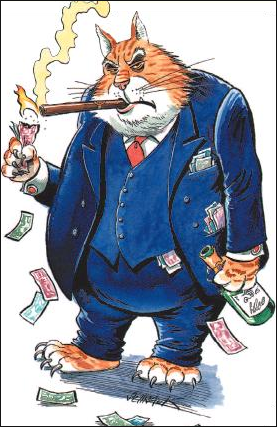
- Owners, managers and employees are all human, and as old age approaches there is a natural motivation to be remembered for a life that had some meaning, and somehow made a difference. In the past, the great pyramids and empires have been built, paintings and books have been created, and today globalized football-businesses straddle the land with towering concrete and glass architectural ‘gems’ of stadia, all trying to signal “legacy”. However, among an increasing number of supporters, young and old, there is a growing awareness that accumulated wealth and powerful global business empires are only symbols of conceit, self-centeredness and greed. This conspicuous arrogance and narcissistic behaviour of certain football clubs and their leaders is ‘successful’ only in terms of ‘making-a-killing’!
Literally, their pile of profit is clawed together by a careless exploitation of other people and organizations. Perhaps the best legacy that these club owners can leave behind them an unpolluted image and a few happy memories (e.g. Leicester City Football Club).