Some 50 years ago, the Social Psychologist, Stanley Milgram conducted his now notorious ‘electric-shock’ experiment[1]. Participants were told by a white-coated authority figure to give repeated shocks to a fellow volunteer in order to enhance their performance on a memory recall task.
Over 65% of the participants administered the maximum level of shock (450 volts) despite their apparent victim screaming in pain and demanding to be freed.
The series of experiments were begun in 1961, coinciding with the war crimes trial of Adolf Eichmann in Israel. It was Milgram’s intention to show that under special circumstances anyone could be made to act against their conscience and commit acts of violence and inhumanity. His argument was that we are all susceptible to authority figures and that the symbols of authority, the peaked cap, the uniform, the warrant card or indeed the white coat, are sufficient to induce blind- obedience in some people.
The comparison between the behaviour of the majority of the participants in the experiment and the actions of the Nazi war criminals was an obvious one to make. Was there a distinction to be made between good and evil people, or was it just a matter of a difference in the propensity “just to follow orders?”
Personally, I was always intrigued by this nature versus nurture question at such a fundamental level of human inter-personal behaviour. Other questions relating to possible differences in participants behaviour would focus upon gender, age, generation etc. I would certainly expect a much lower participation level nowadays because of our knowledge of History and the Holocaust. Also, the development of the Internet has led to democratization of information, and with that a much more healthy relationship between people and ‘authority’; in general, the power gradient has been eroded and instructions and orders are more likely to be questioned.
The later meta-analysis studies of Blass[2],[3] found a consistent percentage of participants (> 60%) willing to ‘obey orders’ across different time periods and countries and although Milgram’s original experiments referred to a very different 1940’s Europe, we should perhaps heed his warning:
“When authority is pitted against moral imperatives, even with participants’ ears ringing with the screams of the victims, authority wins more often than not. Asked to carry out actions incompatible with fundamental standards of humanity and morality, relatively few people have the resources needed to resist those claiming to ‘know’.” Milgram (1974)[4]
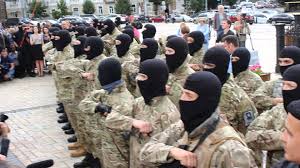
It was a warning then and is now, as power-lines are redrawn in Europe along historical geo-political borders, with the ‘Democratic West’ facing up to the ‘Bolshevik’ threat.
Please take time to read the following which may give some insight into the weltanschauung of the victims in Kiev, province of Galicia, Ukraine.
The 14th Waffen Grenadier Division of the SS (1st Galician), prior to 1944 titled the 14th SS-Volunteer Division “Galician” was a World War II German military formation initially made up of volunteers from the region of Galicia with a Ukrainian ethnic background. At the end of the war in May 1945 it became the first division of the Ukrainian National Army.
The idea to organize a division of volunteers from Galicia was proposed by Otto v. Waechter, the German Governor of the Galicia District. A Waffen-SS division composed of Galician volunteers was created in April 1943. It comprised of ethnic Galicians, who were accepted by Himmler as being “more Aryan-like” than the Slavic Ukrainians and could therefore be accepted into the SS.
This SS-Freiwilligen-Schützen-Division ‘Galizien’ would only be used on the Eastern Front to fight Bolsheviks. The creation of a ‘Ukrainian’ SS division was perceived by many in the Ukraine as a step towards the attainment of Ukrainian independence from Soviet Russia, and attracted many volunteers (over 80,000) at the time.
There are accusations that the Galizien-Division was involved in war crime atrocities in Poland around the villages of Huta Pieniacka, Pidkamin and Palikrowy. In 1986 a Canadian Commission of Inquiry into War Crimes concluded that:
“The Galicia Division (14th Waffen grenadier division der SS) should not be indicted as a group. The members of Galicia Division were individually screened for security purposes before admission to Canada. Charges of war crimes of Galicia Division have never been substantiated, either in 1950 when they were first preferred, or in 1984 when they were renewed, or before this Commission. Further, in the absence of evidence of participation or knowledge of specific war crimes, mere membership in the Galicia Division is insufficient to justify prosecution.”
Let us hope that the present crisis along Russia’s border does not lead to History repeating itself….again!
N. Marlow
September 2014
—
[1] Milgram, Stanley (1963). Behavioral Study of Obedience. Journal of Abnormal and Social Psychology 67 (4): 371–8
[2] Blass, Thomas (1999). “The Milgram paradigm after 35 years: Some things we now know about obedience to authority”. Journal of Applied Social Psychology 29 (5): 955–978.
[3] Blass, Thomas (Mar–Apr 2002). The Man Who Shocked the World”. Psychology Today 35 (2).
[4] Milgram, Stanley (1974). The Perils of Obedience. Harper’s Magazine.